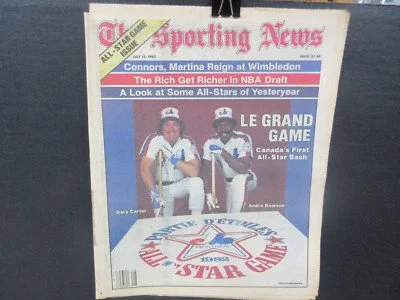
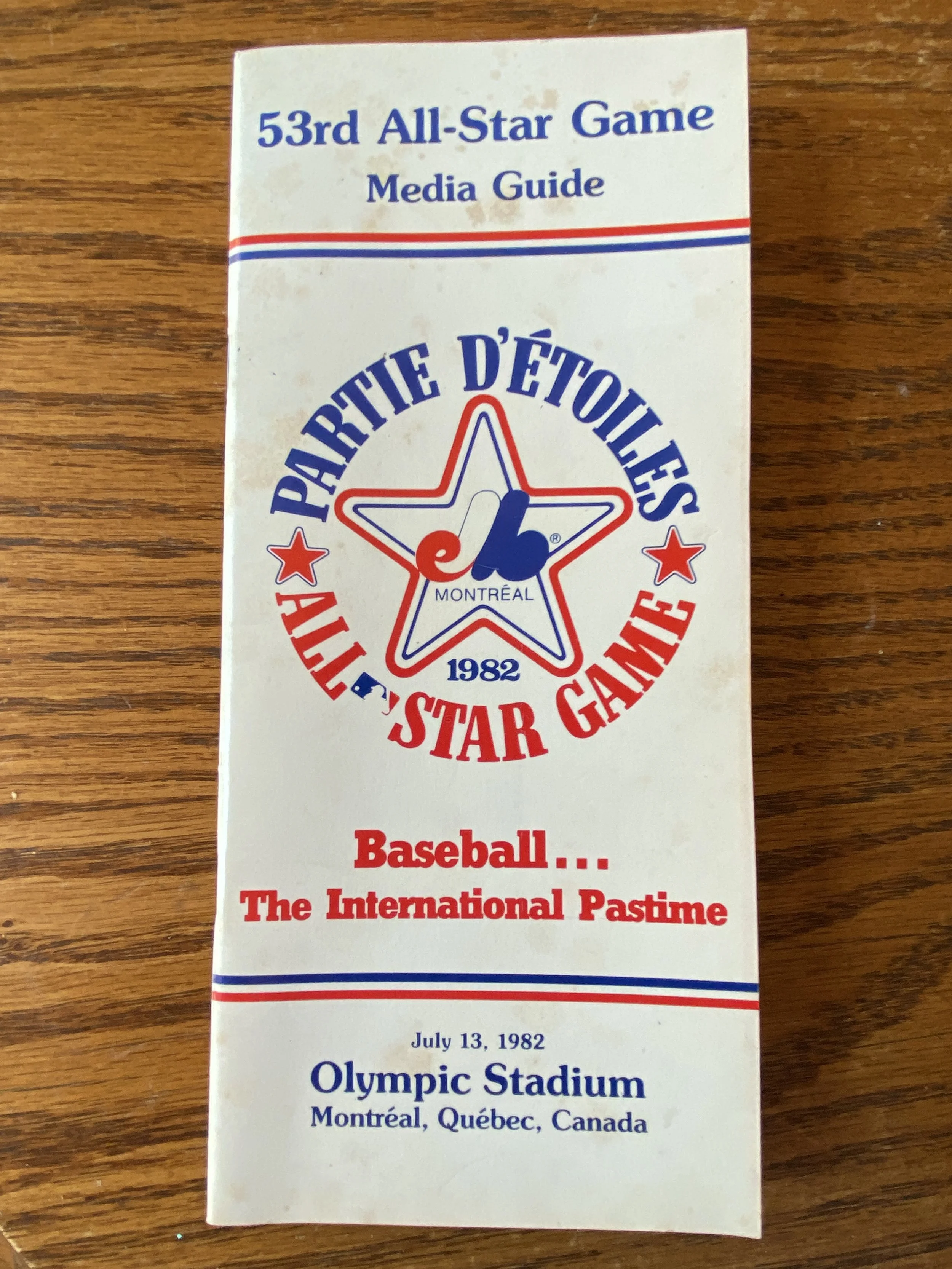
1982 Major League Baseball All-Star Game
July 13, 1982
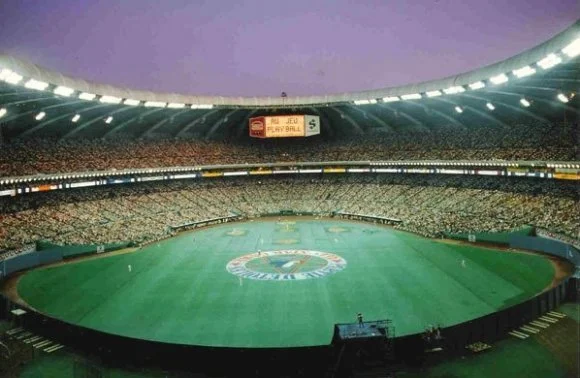
Olympic Stadium - Montreal, Quebec
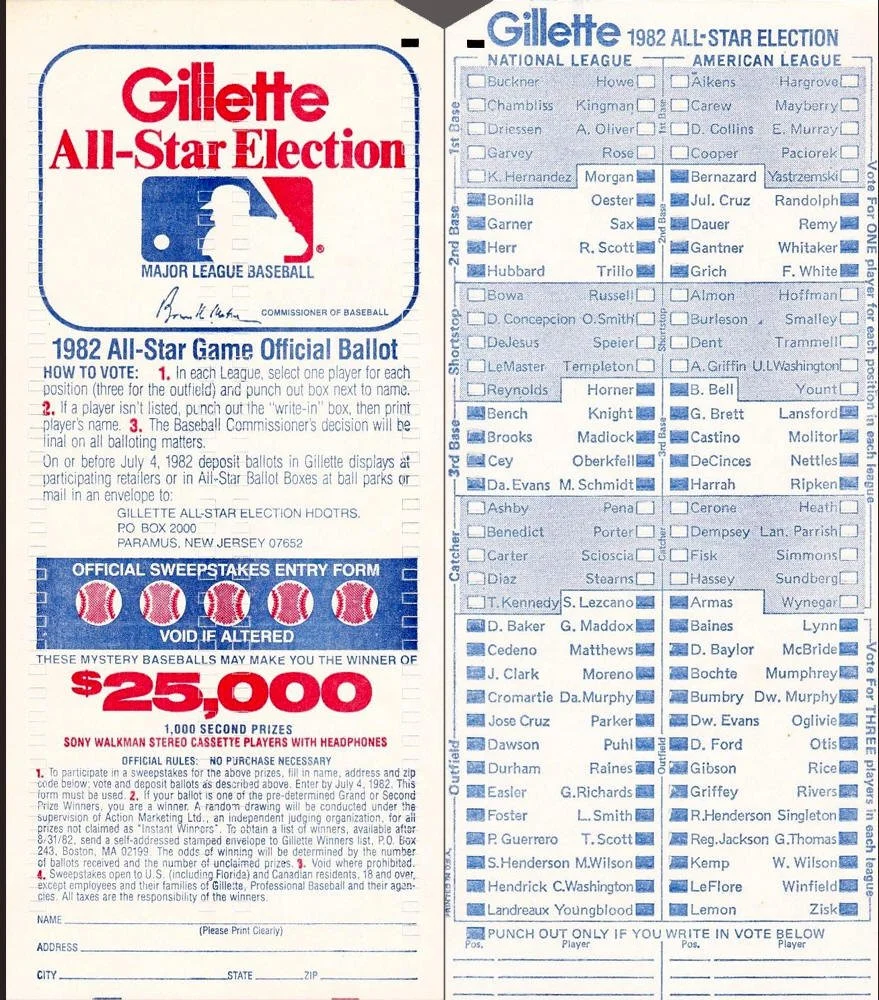
Voting will end at the conclusion of all games on July 4, 1982. A deadline will be posted on this link for those who which to vote one last time.
Announcements of the elected starters and pitchers/reserves will be as follows:
Tuesday, July 6, 1982: American League elected starters
Wednesday, July 7, 1982: National League elected starters
Thursday, July 8, 1982: American League pitchers and reserves
Friday, July 9, 1982: National League pitchers and reserves
Monday, July 12, 1982: Starting Lineups for both the National League and American League will be announced
This article appeared in the July 12, 1982 edition of The Sporting News
Montreal All-Star Fever
11 Nations Join in First Pitch
By Ian MacDonald
Montreal - Staging baseball’s annual All-Star Game is simply another grandiose challenge for Montreal.
Worldly-wise in hosting pretentious events - the World’s Fair (Expo 67) and the Olympic Games (1976) - the city is primed for whatever lies ahead.
This is a big league city with an infectious joix de vivre. From the dancing lights of the discos on Rue St. Denis and Crescent Street to the boutiques and marvelous restaurants of Old Montreal, this island city is looking eagerly for greater obstacles to hurdle.
The first All-Star contest outside of the United States will have an international flavor. Visitors will be reminded constantly of the theme for the game: “A Salute to International Baseball.”
Olympic Stadium, site of the game, will be gaily decked with the flays of the 47 countries in the International Amateur Baseball Federation.
And in an immensely nostalgic touch, the organizing committee, in cooperation with the Montreal Expos, have arranged for a unique first-ball ceremony.
Working with the commissioner’s office, these groups have arranged to have 12 former starts, representing 11 countries, simultaneously throw the ceremonial first pitch.
The 11 countries are Canada, Cuba, the Dominican Republic, Japan, Korea, Mexico, Panama, Puerto Rico, Scotland, the United States and Venezuela.
Most of the 12 players expected to take part in the first-ball ceremony have appeared in an All-Star game. The representatives of Japan and Korea were super stars in their own countries.
The Expos were withholding announcement of the Canada and United States representatives pending final confirmation from the former players.
Latin American countries will be represented by Minnie Minoso (Cuba), Bobby Avila (Mexico), Manny Sanguillen (Panama), Orlando Cepeda (Puerto Rico), Juan Marichal (Dominican Republic) and Luis Aparicio (Venezuela).
Bobby Thomson, whose home run enabled the New York Giants to defeat the Brooklyn Dodgers in the 1951 pennant playoff, will represent Scotland.
Representing the Orient will be Japan’s Shigio Nagashima, five-time MVP and nine-time batting champion of Japanese baseball, and Isao Harimoto, of Korea. Harimoto, whose Korean name is Chabg Hoon, was an MVP in the Japanese Pacific League.
Background for this ‘different’ ceremony will be young, uniformed Montreal baseball players carrying the flags of the 47 countries in the International Federation. Dr. Robert E. Smith of Greenville, Ill., the Federation president will preside over the ceremony.
The three-dau festivities will be highlighted by the annual All-Star party Monday night July 12, in the Salle Maisonneuve of Place des Arts. The Montreal Symphony Orchestra will provide the entertainment.
From a Sunday evening cocktail reception at the headquarters, Bonaventure Hotel, visiting dinitaries will be on a whirlwind pace of breakfasts, luncheons, cocktail parties and ultimately- the game itself.
Montreal fans have not been forgotten in the preparations. They will be in on the fun as well.
These are the fans who look to this event as another step toward what they fully expect will be their ultimate baseball experience- a World Series at Olympic Stadium. Montrealers scooped up every available ticket months ago.
During a July 9-11 weekend series with the San Francisco Giants, the Expos planned to stage several specials in conjunction with the All-Star Game. All-Star posters were to be given away on Friday night. On Saturday, the offering was All-Star buttons and a mammoth fireworks display after the game in the adjacent Maisonneuve Park.
Then, before the Sunday game July 11, those former major league greats who will be taking part in the first-ball ceremony at the big game were to play a couple of innings against an all-star team of greats from all walks of Canadian athletics.
The open-to-the-public workouts for the National League and American League squads were scheduled July 12, completing the All-Star countdown.
1982 - National League All-Stars
Elected Starters
1B -
2B -
SS -
3B -
C -
OF -
OF -
OF -
Pitching Staff
Reserves
Manager - Tommy Lasorda, Los Angeles
Coach - Jim Fanning, Montreal
Coach - John McNamara, Cincinnati
Coach - Chuck Tanner, Pittsburgh
Coach - Joey Amalfitano, Cincinnati
Coach - Mark Creese, Los Angeles
Trainer - Gene Geiselmann, St. Louis
Trainer - Rob McClain, Montreal
Honary Captain - Duke Snider
1982 American League All-Stars
Elected Starters
1B -
2B -
SS -
3B -
C -
OF -
OF -
OF -
Pitching Staff
Reserves
Manager - Billy Martin, Oakland
Coach - Sparky Anderson, Detroit
Coach - Dick Howser, Kansas City
Coach - Art Fowler, Oakland
Coach - Jackie Moore, Oakland
Coach - Eldrod Hendircks, Baltimore
Trainer - Bill Behm, Detroit
Trainer - Mickey Cobb, Kansas City
Honary Captain - Yogi Berra
ALL-STAR GAME SCHEDULE
SUNDAY, JULY 11
7:00 P.M. - Midnight - Media and Baseball Hospitality (cocktails and hors d’oeuvres), Westmount Room, Bonaventure Hotel.
MONDAY, JULY 12
8:00 A.M. - 10:00 A.M. - Breakfast, Westmount Room, Bonaventure Hotel (admittance by Hospitality Card).
11:00 A.M. - Media Conference (managers, starting pitchers, other players, honorary captains), Mt. Royal Room, Bonaventure Hotel.
Noon - 1:30 P.M. - Luncheon, Westmount Room, Bonaventure Hotel
1:00 P.M. - Press Gates Open for Workouts
1:00 P.M. - Olympic Stadium Gates open to Public (free of charge) for Workouts.
3:00 P.M. - 4:00 P.M. - National League Workout.
4:00 P.M. - 5:00 P.M. - American League Workout.
7:00 P.M. - Midnight - Media and Baseball Party (including dinner, show, dancing), Place des Arts (by invitation only).
TUESDAY, JULY 13
8:00 A.M. - 10:00 A.M. - Breakfast, Westmount Room, Bonaventure Hotel.
10:00 A.M. - BBWAA Meeting, Mini-Theatre, Place Bonaventure
10:00 A.M. - 11:00 A.M. - Baseball Chapel Service, Verdun Room, Bonaventure Hotel.
Noon - 2:20 P.M. - Commissioner’s Luncheon, Montreal Ballroom, Bonaventure Hotel (by invitation only).
5:00 P.M. - Press Gates Open.
5:00 P.M. - Olympic Stadium Gates Open.
5:15 P.M. - National League Batting Practice.
6:15 P.M. - American League Batting Practice.
7:10 P.M. - FIELD CLEARED, CLUBHOUSE CLOSED.
7:10 P.M. - 7:20 P.M. - National League Infield Practice.
7:20 P.M. - 7:30 P.M. - American League Infield Practice.
7:50 P.M. - Pre-Game Entertainment
8:18 P.M. - Introduction of Players
8:30 P.M. - American and Canadian Anthems
8:35 P.M. - Ceremonial First Pitch
8:40 P.M. - 53rd All-Star Game
Midnight - 3:30 A.M. - Post-Game Hospitality, Level 200, Olympic Stadium (Admittance by Hospitality Card).
WEDNESDAY, JULY 14
8:30 A.M. - 11:30 A.M. - Breakfast, Portage Room, Bonaventure Hotel.

This article appeared in the July 12, 1982 edition of The Sporting News
Host City Once a Jewel of Minors
by Lowell Reidenbaugh, Senior Editor
On July 13 a stream of extraordinary baseball talent will flow northward and eastward to Montreal, site of the 53rd major league All-Star Game.
The direction of the flow will be in sharp contrast to that taken from 1947 to 1956, when the talent flow followed a steady southerly course, from Montreal to Brooklyn, home of all that was good and brassy and zany in baseball.
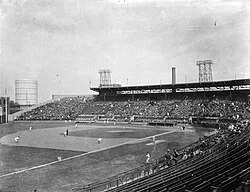
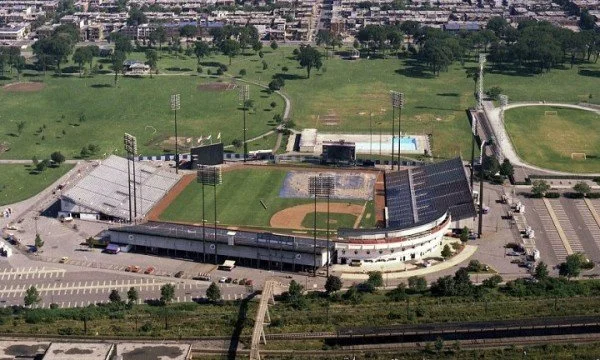
In that golden era, Montreal was a favored city on the baseball map. The metropolis housed the Dodgers’ International League farm club, and, as such, was a port of embarkation for the countless prodigies who contributed so handsomely to six Brooklyn pennants in that exhilarating decade.
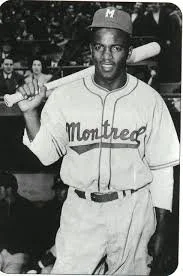
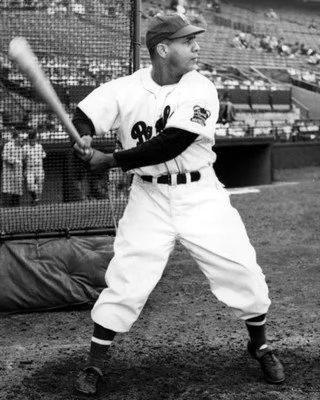
Through the portals of Delorimier Stadium passed Jackie Robinson, Duke Snider, Carl Erskine, Roy Campanella, Don Newcombe and countless others immortalized by Roger Kahn in “Boys of Summer.”
Montreal was the beau ideal of minor league cities, a community with intense pride in its baseball team and a string of championships to reward the public’s enthusiasm.
Frequently, Montreal is remembered only as a minor league stronghold and currently as a National League citadel, with an Est Division title to its credit and a quality team that may well add a second consecutive championship this season. But there have been years that the populace would rather forget, starting in 1890 when the city acquired the Buffalo (International) franchise. After six games, three of them on the rod, the city was deemed unsuitable for professional baseball. The team was shifted to Grand Rapids, Mich.
Atwater Park remained unoccupied only a brief time, however. In late June, Montreal developed fresh appeal. The Hamilton (Ont.) club was transferred to Atwater Park, where it remained until the league collapsed on July 5.
The city returned to Organized Baseball in 1897 as a result of disaster elsewhere. When fire destroyed the park of the Rochester team in the Eastern League, forerunner of the International, the club shifted to Montreal. A enant followed in 1898, but by 1902 public apathy caused the team to be transferred to Worcester, Mass. By early August, club owners determined that Worcester was just as unprofitable. Suddenly, Montreal was back in the league.
A manpower shortage, created by World War I, forced suspension of the International League in 1917, but when the circuit resumed operations at the end of hostilities in Europe, Montreal was an absentee. The city remained out of Organized Baseball until 1928 when, with a new $1.5 million stadium, it rejoined the International League. The franchise was owned by George Stallings, who had managed the Miracle Boston Braves of 1914.
The Dodgers acquired the franchise in 1940. Six seasons later, with the end of World War II and with Branch Rickey dictating strategy from headquarters at Ebbets Field, Montreal entered its years of plenty.
Nobody contributed more to the Montreal success saga than Jackie Robinson. Signed by the Dodgers as the first black player in modern baseball, Robinson won quick acceptance in Montreal, where racial prejudice was almost nonexistent. Robinson made his home debut on May 1, 1946, receiving a thunderous welcome from 15,745 fans as he singled once, started two double plays and figured prominently in the Royals’ 12-9 victory over Jersey City.
Robinson won the league batting championship (.349) as well as most valuable player honors as the Royals won the pennant by 18 ½ games, captured the club’s first Governor’s Cup by defeating Syracuse and then won their first Junior World Series championship by eliminating Louisville of the American Association in six games.
Robinson was on his way to Brooklyn and a career that led to the Hall of Fame.
By 1947, Roy Campanella was capturing Montreal’s collective heart, leading the league’s catchers in putouts, assists and fielding percentage as he, like Robinson before him, laid the groundwork for an illustrious career that carried him into the Cooperstown shrine.
The postwar boom was in full flower by 1948 and the Royals’ attendance skyrocketed to 600,000. Don Newcombe won 17 games and Duke Snider, in 77 games, batted .327 with 17 home runs and 77 runs batted in.
As they had done two years earlier, the pennant-winning Royals brought the season to a smashing climax by defeating Rochester and Syracuse in the Shaughnessy playoffs before defeating St. Paul, four games to one, in the Junior World Series.
Carl Erskine made a brief stop in Montreal in 1950, just long enough to win 10 games before moving on to Brooklyn, where he piced up seven more victories before the close of the season.
The Royals, who had qualified for the Junior World Series in 1949 and ‘51, but bowed to Indianapolis and Milwaukee, respectively, annexed their final Junior Series crown in 1953, beating the Kansas City Blues, four games to one.
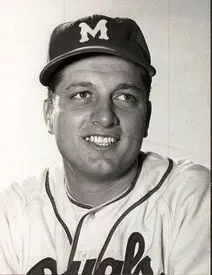
The winner of the third game was a 27-year-old lefthander who beat the Blues, 5-3. He will return to Montreal as the 54-year old manager of the National League All-Stars, Tommy Lasorda.
As Montreal baseball flourished, so did it founder. Attendance that once had been the envy of many major league clubs plunged to 111,000 in 1960 andd although league President Frank Shaughnessy vowed that “there will always be an International League club in Montreal,” Delorimier Stadium was dark when the 1961 season dawned. The city of 2,000,000 population was without Organized Baseball, replaced by Syracuse (pop. 300,000).
Analysts attributed the rapid fadeout to a variety of reasons. Some critics blamed television, some mediocre teams, others on inadequate parking facilities and still others on the slum areas that had encroached on the stadium.
Nor were the Dodgers faultless. Branch Rickey had moved on. The Dodgers were now based in Los Angeles and had transferred their Triple-A operation to Spokane of the Pacific Coast League. Delorimier Stadium had been sold.
The Montreal-Brooklyn baseball tradition was extinct and the Canadian city’s city civic pride lay framented like a dime store bat against a Nolan Ryan fastball.
But the city of the Robinsons and Sniders, the Campanellas and Newcombes was not irretrievably lost. By the summer of 1968 a new groundswell of enthusiasm was evident. National League directors awarded Montreal an expansion franchise provided a suitable playing site was available by the 1969 season. Initially, sentiment favored the Autostade, a remnant of the 1967 Exposition. The site was rejected when it was determined that additional seats and a dome would cost approximately $7 million.
As an 11th-hour substitute, Mayor Jean Drapeau suggested Jarry Park, a 3,000-seat field in a recreational complex. It did have certain advantages, however. It was in easy access of the subway, an expressway and a railroad. A guarantee that the park capacity would be increased to 30,000 by 1969 sealed the deal. The Montreal Expos, named for the 1967 Exposition, made their National League debut in April, 1969, beating the St. Louis Cardinals.
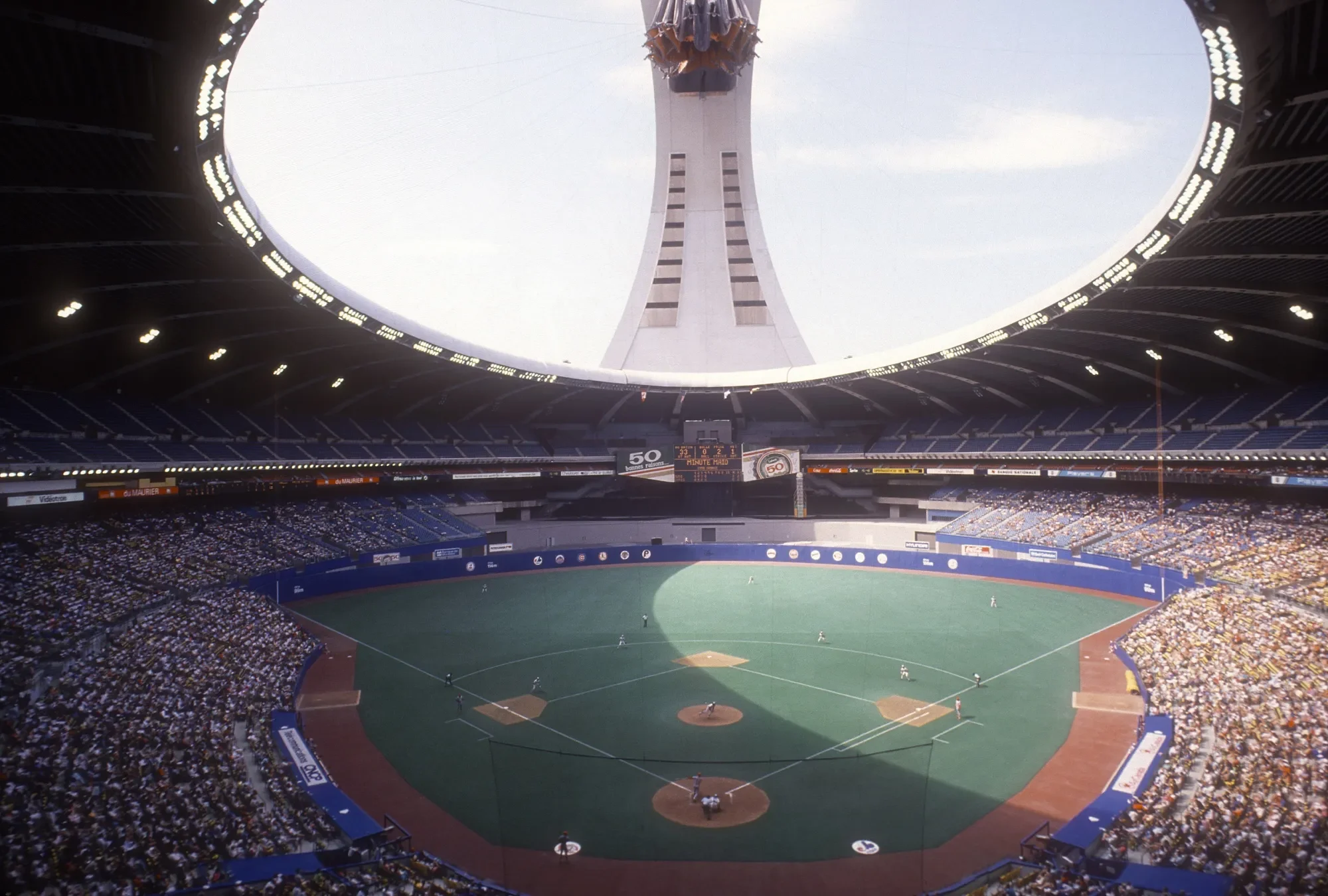
Although a modern stadium had been promised at an early date, the Expos performed in cramped Jarry Park for eight seasons. In 1977 they moved into Olympic Stadium, constructed for the international games of the previous year.
The stadium was about all that a major league could ask for, with one exception. The retractable, umbrella-like roof was missing.
Manufactured in France, the cover reposed in Lyons, piling up rental charges while the Province of Quebec searched for funds to import and install it.
But who needs a roof when a new baseball tradition is germinating in a 59,000-seat stadium? Old ties have been severed and old personalities replaced by such names as Gary Carter, Andre Dawson, Warren Cromartie and Steve Rogers.
The Expos barely missed division titles in 1979 and ‘80, but they succeeded in 1981, only to lose out in the National League Championship Series to, of all clubs, the Los Angeles Dodgers, managed by, of all people, a hero of Montreal’s 1953 champions, Tommy Lasorda.